Our Research and Impact
Our Research and Impact
Tackling real-world challenges to advance research while driving social impact and innovation
Disability-focused prototypes
Downloads
SDG-focused startup pitches
Innovators involved
Featured on:





raised

To Be Announced: Our Project in Vietnam
By Chan Park and Xiaomeng Gu
To Be Announced: Our Project in Vietnam on innovation for individuals with disabilities

Some Problems Have to Be Felt: The Limits of Vicarious Learning
By Chan Park and Vivek Chaudhary
Key takeaway: Vicarious learning is an efficient substitute for experience when the knowledge you need is about the solution, which is concrete and observable. It falls short when the knowledge you need is about the problem, which is rooted in physical and sensory experience. When the hard part is understanding what users actually face, put your team through the experience instead of describing it to them. Organizational learning research has long treated vicarious learning as a practical substitute for experiential learning. Learning by doing is slow, costly, and constrained by what happens to be available locally. Learning by watching others is cheap, fast, and can draw on a much wider pool of examples. The usual conclusion is that organizations should lean on observation and imitation wherever they can. This project identifies a boundary condition to that logic: the problem space. The distinction that matters is between solution knowledge and problem knowledge. Solution knowledge is concrete and observable. You can watch how something is built, copy a design, or reverse-engineer a working product, and the knowledge transfers reasonably well. Problem knowledge is different. It is grounded in physical and sensory experience, in what a situation actually feels like from the inside. That kind of knowledge resists observation. You can be told about it accurately and still not have it. The prediction follows directly: when learning targets the problem rather than the solution, experiential learning should outperform vicarious learning in enabling innovative solutions. To test this, the project ran a preregistered randomized field experiment with teams at a two-day hackathon focused on stroke rehabilitation, where teams generated and implemented hardware–software solutions. Treated teams performed physical activities that simulated stroke symptoms, experiencing the impairments directly in their own bodies. Control teams received equivalent knowledge vicariously, through video and through interaction with therapists. This is worth emphasizing: the control condition was not information-poor. Teams in both conditions had access to the same underlying knowledge. What differed was the channel through which they got it. The treatment increased innovation. Teams that had physically experienced the symptoms produced more innovative solutions than teams that had learned about them from experts and video. Post hoc analysis points to a more nuanced mechanism than a simple boost to creativity. The effect operated through the value of the solutions rather than their novelty. Teams that had experienced the problem developed a deeper and more accurate understanding of it, and that understanding showed up in solutions that were genuinely more useful. Novelty, by contrast, tracked technical expertise: how unusual a solution was depended largely on what a team was technically capable of building. Experiencing the problem did not make teams more inventive in the abstract. It made their inventiveness land on the things that mattered. For practice, this reframes a common assumption about empathy work. Simulation exercises, user shadowing, and immersive site visits are often treated as motivational or as a way to build commitment to a project. This project suggests they do something more specific: they transfer a kind of problem knowledge that briefings, videos, and expert interviews cannot fully deliver, however well those are executed. Expert testimony remains valuable, but it is not a substitute for the experience itself. The practical guidance is therefore about allocation. If a team's constraint is technical, invest in expertise and in exposure to existing solutions, where vicarious learning is efficient and effective. If a team's constraint is understanding the problem, spend the time and the cost on direct experience. Knowing which of those two constraints you face is itself part of the work.
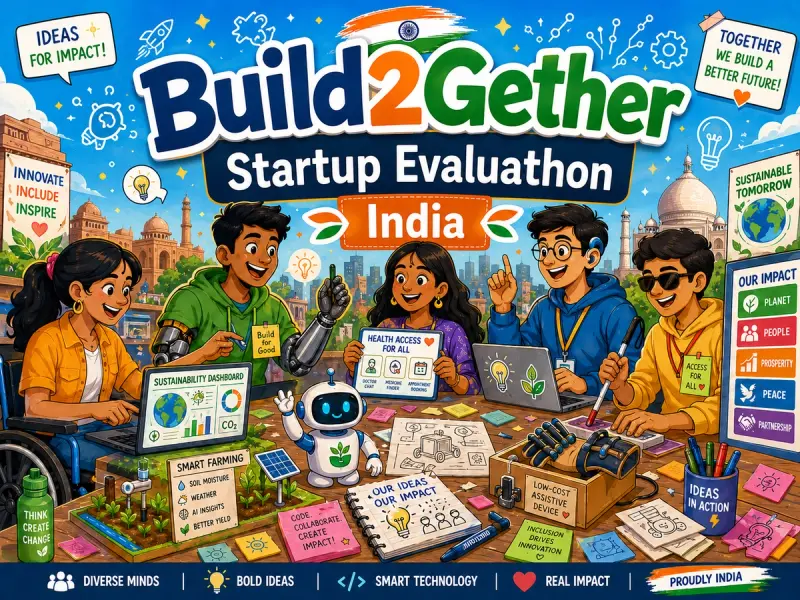
To be Announced: Upcoming Startup Evaluathon in India
By Kim Claes, Cyrille Grumbach, and Savindu Herath
To be Announced: Upcoming Startup Evaluathon in India with 1,000+ evaluators!
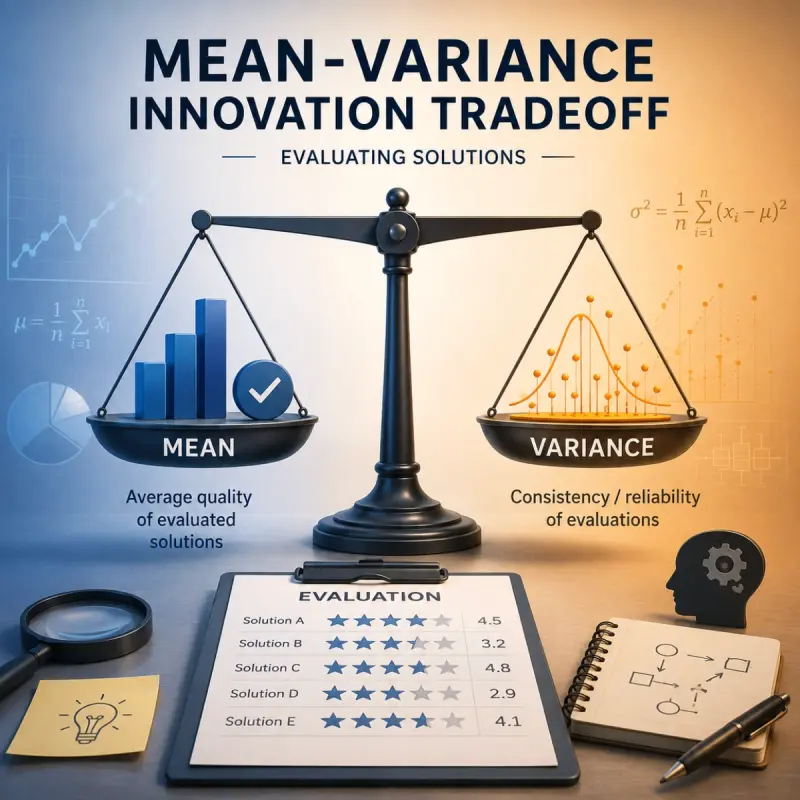
The Mean-Variance Innovation Tradeoff in Evaluations
By Cyrille Grumbach, Jackie Lane, and Georg von Krogh
Key takeaway: The criterion you apply first determines which solutions remain in contention at all. A criterion applied second can only reject; it cannot recover what the first screen already discarded. Lead with feasibility for a reliably strong portfolio, lead with novelty to keep moonshots alive, and use AI assistance when you want to raise the average without letting weak ideas through. This project looks at a stage of innovation that often gets less attention than idea generation: evaluation. When an organization or a contest receives hundreds or thousands of submissions, the choices made during screening shape both the rate and the direction of innovation. At the center of that process sits a familiar tension between novelty and feasibility. Evaluators cannot give equal weight to both criteria at the same moment, so in practice they sequence them, prioritizing one criterion at a first stage and the other at a second. What has not been clear is whether that sequence is a neutral procedural detail or a decision that quietly determines the outcome. To find out, the project ran two field experiments with 2,723 evaluators, producing 54,460 solution–evaluator pairs. Evaluators were randomly assigned to one of two sequences. Some screened first for feasibility and then for novelty. Others screened first for novelty and then for feasibility. Each sequence was also run with and without AI assistance, so the project could test whether an AI partner changes the dynamics of the tradeoff. The results show what the project calls a mean–variance innovation tradeoff. A feasibility-then-novelty sequence produced selections with higher average innovation. A novelty-then-feasibility sequence produced greater variance in innovation. Neither sequence is simply better. One delivers a dependable portfolio, the other delivers a wider spread that includes both weaker picks and more extreme upside. AI assistance did not eliminate this pattern. The tradeoff persisted whether or not evaluators had AI support. What AI assistance did do was shift the whole distribution: it raised the mean and compressed the variance, and it helped evaluators catch more "stars," the solutions that are both highly novel and highly feasible. In other words, AI improved the quality of screening without resolving the underlying tension between the two criteria. The project also shows when sequencing matters and when it does not. When the two criteria are aligned, meaning a solution scores high on both or low on both, the order made little difference. Easy cases stayed easy. Sequencing became decisive when the criteria diverged. A novelty-then-feasibility sequence preserved more "moonshots," the atypical solutions that are only barely feasible. A feasibility-then-novelty sequence favored "safe bets," solutions that are workable but conventional. The order, in effect, chooses which kind of imperfect solution gets a second look. The evaluators' own stated reasons explain the mechanism. At the first screen, they invoked their assigned criterion to justify both the solutions they accepted and the ones they rejected. At the second screen, the assigned criterion shaped only their rejections. A criterion applied second therefore operates through exclusion rather than selection. It can remove candidates from the surviving pool, but it cannot reach back and rescue anything the first screen already eliminated. Whichever criterion leads determines the set of solutions that remain in play. For practice, the implication is concrete. Sequencing is not an administrative detail to be settled by convenience or habit; it is a strategic lever that should follow from the goal of the evaluation. If the objective is a solid slate of implementable solutions, put feasibility first. If the objective is to find the rare idea that changes the field, put novelty first and accept the wider spread that comes with it. And if the aim is to lift overall quality, AI assistance helps, but it will not choose the direction for you. That choice is still made the moment you decide which criterion goes first.
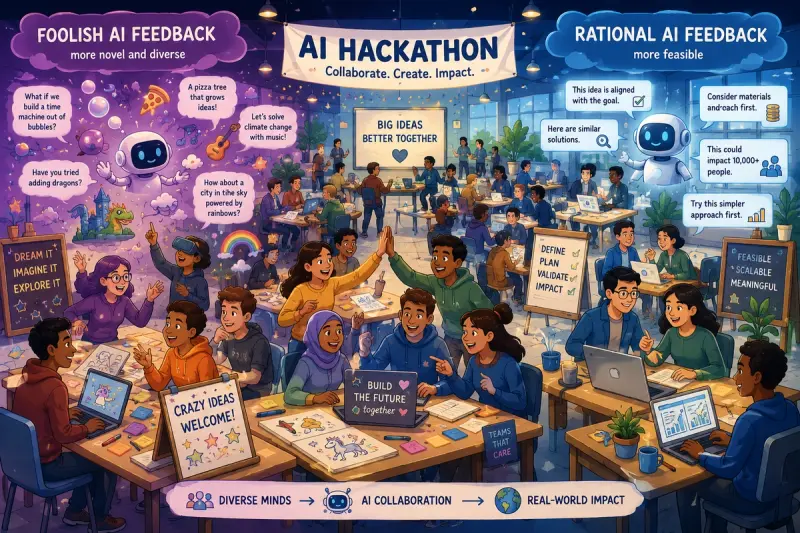
"Foolish" AI Feedback Drives Innovation by Flagging What Already Exists
By Cyrille Grumbach, Chan Park
Key takeaway: The widely claimed homogenizing effect of AI may come down to how we use it. Used to directly improve proposals toward predefined goals, AI boosts feasibility but narrows the range of ideas, because it draws heavily on what has already worked. Used instead to flag redundancies — to point out which elements are genuinely novel versus already out there — AI helps teams generate more novel and diverse ideas (though often less feasible). The lesson: use AI to question proposals, rather than to improve them. This project started with a worry you have probably heard: that generative AI homogenizes ideas, nudging everyone toward the same safe answers and shrinking the diversity of what gets made. We wanted to know whether that effect is really baked into AI — or whether it depends on how AI is used. So we studied the use of AI during a 24-hour hackathon involving 1,946 innovators across 489 teams, all working on innovation for grand challenges. Teams were randomly assigned to receive one of two types of AI feedback on their innovation goals and ideas. Half received feedback aimed at directly improving their ideas to better reach and fit predefined goals — the way AI is typically used today. The other half received feedback that identified redundancies between their proposals and what already exists, encouraging them to experiment with alternative goals and ideas. After teams submitted, 106 expert evaluators rated each proposal for novelty and feasibility, and we measured the diversity of ideas across each group. The results flipped the homogenization story on its head. When AI was used to question proposals and help distinguish which elements were novel versus already existing, teams generated more novel and diverse ideas — though these ideas were often less feasible. The widely claimed homogenizing effect of AI may therefore stem from how it is typically used: to offer direct improvements on what is proposed. That use is genuinely good for feasibility, because it draws heavily on what has worked before — but that is exactly what narrows the range of ideas. The very property that makes AI prone to homogenizing — its grip on what already exists — becomes a strength the moment you point it at spotting redundancy rather than smoothing toward it. Behind these two ways of using AI sit two different philosophies of feedback, and naming them helps explain the results. The first we call rational feedback: input aimed at aligning and improving ideas so they better meet a predefined target. It is essential for reliable, incremental progress, and it dependably produces feasible ideas — but it quietly steers people toward the safe and expected. The second we call foolish feedback: input that encourages people to experiment with unexpected ideas and be playful, rather than stick to the obvious path they started on. A quick word on "foolishness," because it is doing real work here. The term comes from organizational scholar James March, who noticed that organizations almost always act rationally — they decide what they want, then move straight toward it. March argued that there is hidden value in a complementary foolish mode: being willing to wander, experiment, and be playful rather than locking in early on certain goals. It looks irrational because it doesn't serve the original goal. That is exactly the point — and it is what gives foolish feedback its edge on novelty and diversity. Looking closer at why foolish feedback works, two behaviors explained the effect. The first was experimentation — teams treating their ideas as experiments to run and see what happens, rather than answers to defend. This is what pushed novelty up. The second was playfulness — teams treating the work as low-stakes play, where ideas didn't have to line up neatly with what they set out to do. Playfulness lowered feasibility, as you'd expect, but it raised diversity. So foolish feedback didn't just produce "weirder" ideas at random; it changed how teams worked — more experimenting, more playing — and that is what opened room for novel and varied directions. For practice, the message is clear. If your aim is reliable execution, rational feedback — and AI used to improve and tighten proposals — is the right tool, and it will reward you with feasibility. But if your aim is innovation, that same feedback can quietly cap how novel and diverse your ideas get. Consider giving people, and your AI tools, permission to be a little foolish: to experiment and play, not just refine. And rethink what you ask AI to do. Its most valuable contribution to creativity may not be making ideas better, but showing you where they are merely repeating what the world already knows — so you can go somewhere new. Thanks to Sairam Institutions for hosting and organizing this wonderful hackathon!
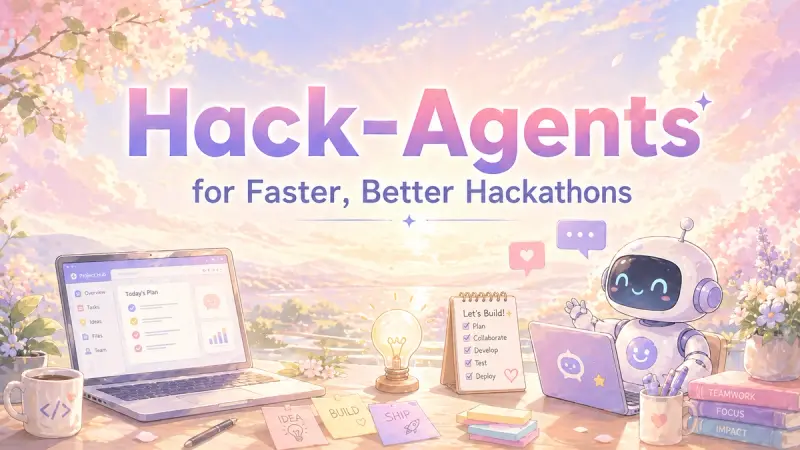
Hack-Agents for Faster, Better Hackathons
By Lu Li, Savindu Herath, and Cyrille Grumbach
Key takeaway: Using the same AI support throughout a hackathon can push teams toward familiar ideas too quickly. This project shows that phase-specific assistance can preserve exploratory ideation, support efficient implementation, and improve evaluation. Reference for the paper: Li, L., Herath, S., & Grumbach, C. (2026, April). Hack-Agents: A Multi-Agent System for Innovation-Proof of Concept and Implications for AI-Augmented Hackathons. In Proceedings of the 2026 CHI Conference on Human Factors in Computing Systems. https://dl.acm.org/doi/full/10.1145/3772363.3798678 Hackathons move fast. Teams have to generate ideas, build something that works, and evaluate what they created—all under tight time pressure. That is exactly why many innovators now turn to AI for help. These tools can improve efficiency and lower barriers to participation, but they can also create problems. When the same AI support is used in the same way across the whole innovation process, teams may rely on it too much and converge too early on familiar ideas. This project asks a practical question: can AI support be designed to fit the different phases of innovation more effectively? The answer explored here is yes. Instead of giving innovators one single chatbot for the entire process, the project developed Hack-Agents, a multi-agent system for innovation that changes its role across ideation, implementation, and evaluation. The system uses scaffolding at two levels. At the macro level, it structures the process into three phases: ideation, implementation, and evaluation. This helps innovators avoid rushing straight into building before stabilizing their problem understanding, and it creates space to reflect on outcomes and future improvements. At the micro level, each phase has its own agent. The Ideation Agent promotes divergent exploration by asking probing questions and surfacing alternative framings. The Implementation Agent provides more continuous support to help innovators resolve technical uncertainties and execute a selected approach. The Evaluation Agent helps innovators assess outcomes and trade-offs while also reflecting on possible improvements. The system was implemented and deployed in several innovation-focused hackathons, involving hundreds of innovators (Autumn 2025). The results are highly relevant for anyone designing AI-augmented hackathons. They show that aligning AI assistance with the distinct phases of innovation can reduce over-reliance and premature convergence. In practice, that means teams can keep ideation more exploratory, move through implementation more efficiently, and approach evaluation in a more deliberate way. For organizers and designers of innovation processes, the message is clear: AI support works better when it changes with the work innovators are doing.
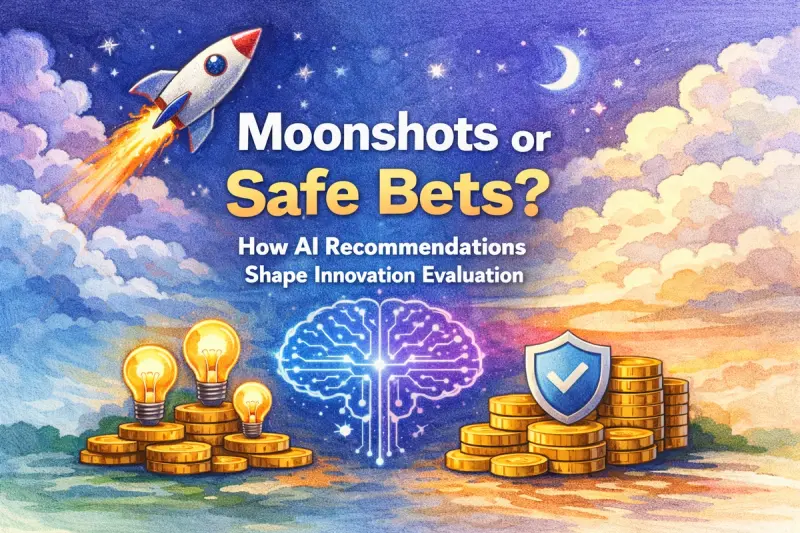
Moonshots or Safe Bets? How AI Recommendations Shape Innovation Evaluation
By Cyrille Grumbach, Jackie Lane, and Georg von Krogh
Key takeaway: Sequence matters when feasibility and novelty pull in different directions. If you want reliable incremental innovations, use feasibility-focused AI recommendations first and novelty-focused AI recommendations second; if you want moonshots, reverse the order. This project looks at a practical question that many organizations now face: when people evaluate many possible solutions, should they look at feasibility first or novelty first? How can AI most effectively assist evaluators when multiple criteria must be considered? That choice may sound small, but it can shape which ideas survive and which ones get filtered out. To study this, we partnered with Hackster.io, a leading crowdsourcing platform. We first launched an innovation contest that generated 132 open-source solutions. Then we run a series of preregistered field experiments with thousands of evaluators from Sairam Institutions (India) using a two-stage evaluation process. Evaluators were randomly assigned to one of two sequences: feasibility-then-novelty or novelty-then-feasibility. In both cases, AI recommendations helped guide evaluators during the evaluation process. The main finding is straightforward and highly relevant for practice. When evaluators started with feasibility, they were more likely to keep solutions that worked within existing constraints and then identify the more novel options within that set. This makes feasibility-then-novelty a strong choice when the goal is reliable incremental innovations: solutions that may be less novel, but are highly feasible. The main finding is clear and highly relevant for practice. When evaluators received feasibility-focused AI recommendations first, they were more likely to keep solutions that worked within existing constraints and then identify the more novel options within that set. This makes the feasibility-then-novelty sequence a strong choice when the goal is reliable incremental innovation: solutions that are highly feasible but not so novel. The reverse sequence produced a different outcome. When evaluators received novelty-focused AI recommendations first, they were more likely to keep unusual and atypical solutions early on, before feasibility was considered later. That sequence was better at surfacing more extreme possibilities. In practice, this makes novelty-then-feasibility the better option when the goal is moonshots: solutions that are highly novel but not feasible given existing constraints. The broader lesson is that organizations should not treat the order of AI recommendations as a minor design detail. The sequence matters when feasibility and novelty are in tension; it becomes a real strategic lever. Teams looking for dependable, near-term outcomes should begin with feasibility-focused AI recommendations. Teams looking for bold bets and future breakthroughs should begin with novelty-focused AI recommendations. Check out how our work was covered by Harvard Business School: https://d3.harvard.edu/how-ai-can-spot-your-next-billion-dollar-idea/ https://www.library.hbs.edu/working-knowledge/ai-trends-for-2026-building-change-fitness-and-balancing-trade-offs Thanks to all the participants of our experiments from Sairam Institutions.
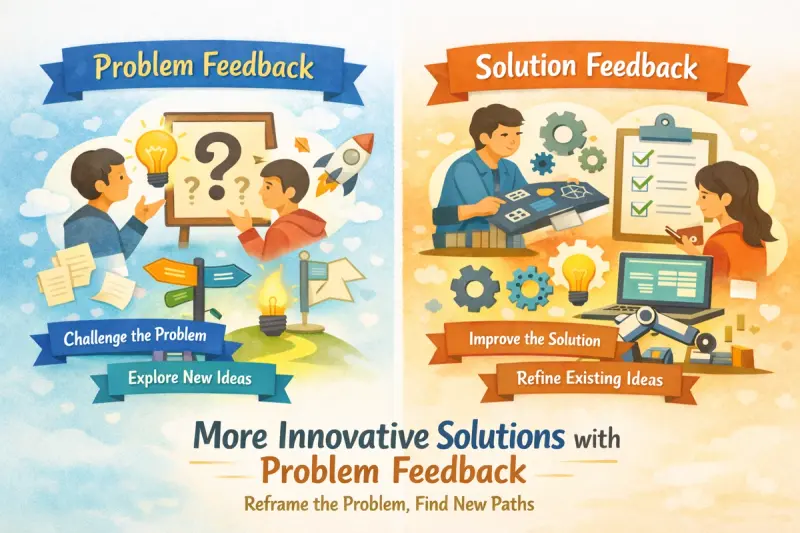
How Problem Feedback Drives Innovation through Search Discontinuity
By Cyrille Grumbach, Chan Park, and Georg von Krogh
Key takeaway: When the broadcast problem is underspecified, the biggest breakthrough may come from challenging how solvers define the problem, not just how they improve the solution. Problem feedback pushed solvers toward new problem formulations and more innovative outcomes This project looks at a core challenge in external search: what happens when seekers broadcast a problem that cannot be clearly specified from the start? In many real settings, the problem is not neatly defined in advance. It appears through partial and ambiguous cues, which makes it hard to know what the “right” problem formulation is. That matters because solvers often build their search around the first formulation they come up with, even when that first formulation is too obvious. To study this, the project examined a six-month global crowdsourcing contest focused on the underspecified problem of disability. Solvers were asked to create innovative solutions that are useful and novel for people with disabilities. In the first half of the contest, each solver submitted a problem formulation and a corresponding conceptual solution. Then they were randomly assigned to one of two conditions. In the treatment condition, they received problem feedback on their problem formulation. In the control condition, they received solution feedback on their conceptual solution. In both conditions, the feedback came from individuals with disabilities before solvers moved on to implementation. The difference mattered. In the second half of the contest, solvers used the feedback to build tangible prototypes. Four seekers then evaluated each implemented solution based on novelty and usefulness. Across 114 implemented solutions, solvers who received problem feedback developed more innovative solutions than those who received solution feedback. The project shows why. Most solvers initially converged on obvious problem formulations. Solution feedback usually kept them working within those same formulations. They explored, but they stayed in the same solution spaces. This led to what the project calls continuous search: search that keeps moving forward from the initial problem formulation. As a result, many solutions remained close to existing market solutions. Problem feedback worked differently. It challenged solvers’ initial problem formulations and pushed them toward alternative formulations in previously unexplored parts of the problem space. That shift redirected their search toward different solution spaces. The project calls this discontinuous search. Instead of refining the same starting point, solvers changed the locus of search and moved toward solutions they would likely not have explored otherwise. For practice, the message is clear. When seekers face an underspecified problem, feedback on the solution may not be enough. If the goal is innovation, it may be more powerful to respond to how solvers formulate the problem in the first place. This project shows that in external search, better innovation can come from changing the problem formulation before improving the solution. All solutions developed through the contest are open source and have been downloaded more than 50,000 times worldwide, creating significant social impact for individuals with disabilities! More about the contest can be found on Hackster.io: https://www.hackster.io/contests/buildtogether2 Our contest has also been featured on ABC News and Forbes! Examples of solutions developed in our innovation contest.
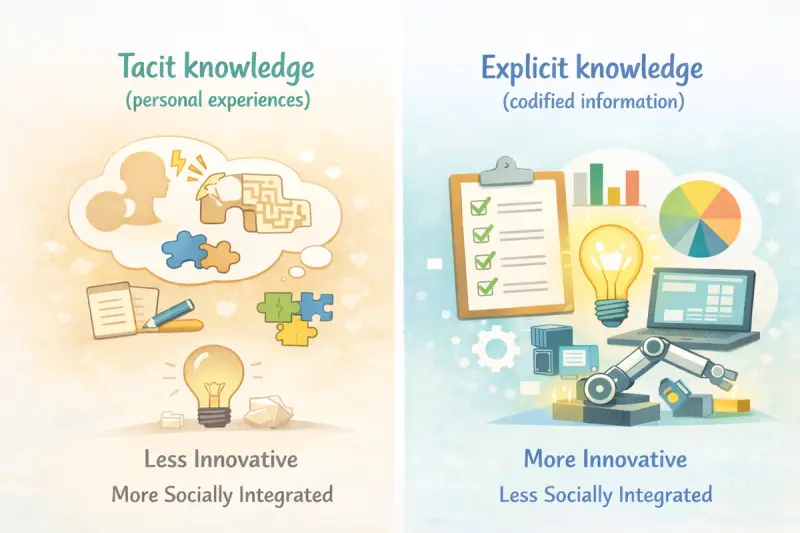
When Sharing Experiences Fails to Drive Innovation
By Cyrille Grumbach, Chan Park, and Georg von Krogh
Key Takeaway: Tacit knowledge is not always better for innovation. In this project, innovators produced more innovative solutions when users shared explicit, codified information than when they shared tacit knowledge through personal experiences, although experience sharing helped users feel more socially integrated. This project examines a simple yet important question: when users face problems that are still poorly understood, what is the best way to help innovators solve them? The study focused on a global crowdsourcing contest on innovation for individuals with disabilities. In this setting, the users had firsthand knowledge of their problems, while the able-bodied innovators did not. The comparison was direct. In one condition, users shared explicit, codified information about their problems. In the other, they shared tacit knowledge through their personal experiences so innovators could learn from them. The expectation was that personal experiences would transfer more of the users’ tacit knowledge and lead to stronger innovation. But that is not what happened. Solutions developed when users shared explicit, codified information were rated by other users facing similar problems as more innovative than solutions developed when users shared personal experiences. Why? The study suggests that experience sharing may not work well when the knowledge is somatic, grounded in embodied experience, such as how users physically feel their problems. Rich personal experiences gave innovators a lot of information, but often too much. Many struggled to identify the central problem and got pulled toward secondary details. By contrast, innovators who received explicit, codified information were better able to focus on relevant problems and develop stronger solutions. For practice, this matters for anyone organizing open innovation around social issues. If the goal is stronger innovation, simply asking users to share personal experiences may not be enough. If the goal is social integration, however, experience sharing still has value, because users feel more socially integrated in that condition. The project shows that organizers may need to design their processes differently depending on whether they want to maximize innovation or strengthen social integration between users and innovators. All solutions developed through the contest are open-source and have been downloaded more than 250,000 times around the world, creating significant social impact for individuals with disabilities! More about the contest can be found on Hackster.io: https://www.hackster.io/contests/buildtogether Our contest has also been featured on ABC News, Forbes, and Make: magazine! Examples of solutions developed in our innovation contest:
© 2026 Build2Gether. All rights reserved.