"Foolish" AI Feedback Drives Innovation by Flagging What Already Exists
Our preregistered field experiment in a 24-hour hackathon with 1,946 innovators revealed that AI which flags redundancies — rather than directly improving ideas toward predefined goals — led teams to generate more novel and diverse ideas.
By Cyrille Grumbach, Chan Park
February 18 to 20, 2026
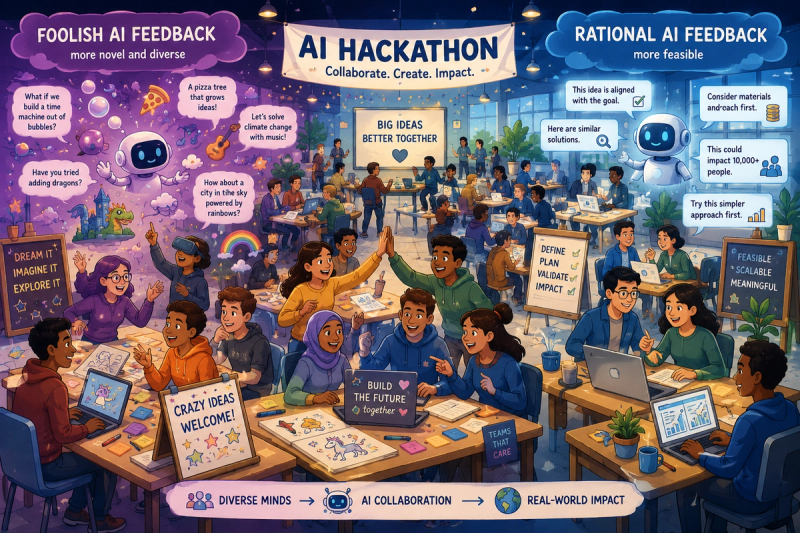
Key takeaway: The widely claimed homogenizing effect of AI may come down to how we use it. Used to directly improve proposals toward predefined goals, AI boosts feasibility but narrows the range of ideas, because it draws heavily on what has already worked. Used instead to flag redundancies — to point out which elements are genuinely novel versus already out there — AI helps teams generate more novel and diverse ideas (though often less feasible). The lesson: use AI to question proposals, rather than to improve them.
This project started with a worry you have probably heard: that generative AI homogenizes ideas, nudging everyone toward the same safe answers and shrinking the diversity of what gets made. We wanted to know whether that effect is really baked into AI — or whether it depends on how AI is used. So we studied the use of AI during a 24-hour hackathon involving 1,946 innovators across 489 teams, all working on innovation for grand challenges.
Teams were randomly assigned to receive one of two types of AI feedback on their innovation goals and ideas. Half received feedback aimed at directly improving their ideas to better reach and fit predefined goals — the way AI is typically used today. The other half received feedback that identified redundancies between their proposals and what already exists, encouraging them to experiment with alternative goals and ideas. After teams submitted, 106 expert evaluators rated each proposal for novelty and feasibility, and we measured the diversity of ideas across each group.
The results flipped the homogenization story on its head. When AI was used to question proposals and help distinguish which elements were novel versus already existing, teams generated more novel and diverse ideas — though these ideas were often less feasible. The widely claimed homogenizing effect of AI may therefore stem from how it is typically used: to offer direct improvements on what is proposed. That use is genuinely good for feasibility, because it draws heavily on what has worked before — but that is exactly what narrows the range of ideas. The very property that makes AI prone to homogenizing — its grip on what already exists — becomes a strength the moment you point it at spotting redundancy rather than smoothing toward it.
Behind these two ways of using AI sit two different philosophies of feedback, and naming them helps explain the results. The first we call rational feedback: input aimed at aligning and improving ideas so they better meet a predefined target. It is essential for reliable, incremental progress, and it dependably produces feasible ideas — but it quietly steers people toward the safe and expected. The second we call foolish feedback: input that encourages people to experiment with unexpected ideas and be playful, rather than stick to the obvious path they started on.
A quick word on "foolishness," because it is doing real work here. The term comes from organizational scholar James March, who noticed that organizations almost always act rationally — they decide what they want, then move straight toward it. March argued that there is hidden value in a complementary foolish mode: being willing to wander, experiment, and be playful rather than locking in early on certain goals. It looks irrational because it doesn't serve the original goal. That is exactly the point — and it is what gives foolish feedback its edge on novelty and diversity.
Looking closer at why foolish feedback works, two behaviors explained the effect. The first was experimentation — teams treating their ideas as experiments to run and see what happens, rather than answers to defend. This is what pushed novelty up. The second was playfulness — teams treating the work as low-stakes play, where ideas didn't have to line up neatly with what they set out to do. Playfulness lowered feasibility, as you'd expect, but it raised diversity. So foolish feedback didn't just produce "weirder" ideas at random; it changed how teams worked — more experimenting, more playing — and that is what opened room for novel and varied directions.
For practice, the message is clear. If your aim is reliable execution, rational feedback — and AI used to improve and tighten proposals — is the right tool, and it will reward you with feasibility. But if your aim is innovation, that same feedback can quietly cap how novel and diverse your ideas get. Consider giving people, and your AI tools, permission to be a little foolish: to experiment and play, not just refine. And rethink what you ask AI to do. Its most valuable contribution to creativity may not be making ideas better, but showing you where they are merely repeating what the world already knows — so you can go somewhere new.
Thanks to Sairam Institutions for hosting and organizing this wonderful hackathon!


© 2026 Build2Gether. All rights reserved.