How Problem Feedback Drives Innovation through Search Discontinuity
Our field experiment in a global crowdsourcing contest revealed that feedback on the problem formulation led solvers to develop more innovative solutions than feedback on the proposed solution itself.
By Cyrille Grumbach, Chan Park, and Georg von Krogh
March 1 to September 1, 2024
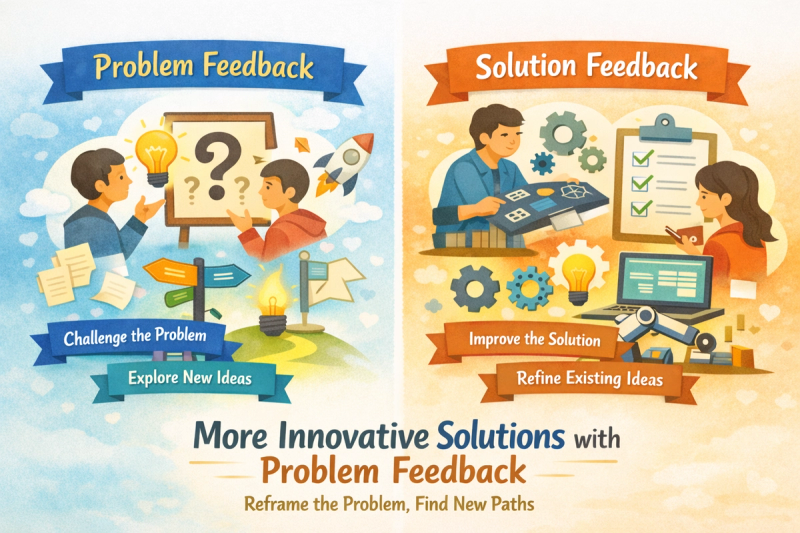
Key takeaway: When the broadcast problem is underspecified, the biggest breakthrough may come from challenging how solvers define the problem, not just how they improve the solution. Problem feedback pushed solvers toward new problem formulations and more innovative outcomes
This project looks at a core challenge in external search: what happens when seekers broadcast a problem that cannot be clearly specified from the start? In many real settings, the problem is not neatly defined in advance. It appears through partial and ambiguous cues, which makes it hard to know what the “right” problem formulation is. That matters because solvers often build their search around the first formulation they come up with, even when that first formulation is too obvious.
To study this, the project examined a six-month global crowdsourcing contest focused on the underspecified problem of disability. Solvers were asked to create innovative solutions that are useful and novel for people with disabilities. In the first half of the contest, each solver submitted a problem formulation and a corresponding conceptual solution. Then they were randomly assigned to one of two conditions. In the treatment condition, they received problem feedback on their problem formulation. In the control condition, they received solution feedback on their conceptual solution. In both conditions, the feedback came from individuals with disabilities before solvers moved on to implementation.
The difference mattered. In the second half of the contest, solvers used the feedback to build tangible prototypes. Four seekers then evaluated each implemented solution based on novelty and usefulness. Across 114 implemented solutions, solvers who received problem feedback developed more innovative solutions than those who received solution feedback.
The project shows why. Most solvers initially converged on obvious problem formulations. Solution feedback usually kept them working within those same formulations. They explored, but they stayed in the same solution spaces. This led to what the project calls continuous search: search that keeps moving forward from the initial problem formulation. As a result, many solutions remained close to existing market solutions.
Problem feedback worked differently. It challenged solvers’ initial problem formulations and pushed them toward alternative formulations in previously unexplored parts of the problem space. That shift redirected their search toward different solution spaces. The project calls this discontinuous search. Instead of refining the same starting point, solvers changed the locus of search and moved toward solutions they would likely not have explored otherwise.
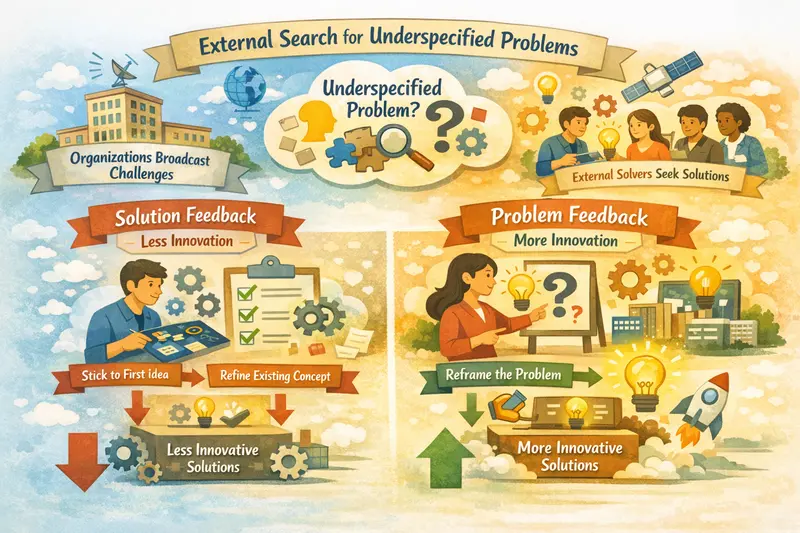
For practice, the message is clear. When seekers face an underspecified problem, feedback on the solution may not be enough. If the goal is innovation, it may be more powerful to respond to how solvers formulate the problem in the first place. This project shows that in external search, better innovation can come from changing the problem formulation before improving the solution.
All solutions developed through the contest are open source and have been downloaded more than 50,000 times worldwide, creating significant social impact for individuals with disabilities!
More about the contest can be found on Hackster.io: https://www.hackster.io/contests/buildtogether2
Our contest has also been featured on ABC News and Forbes!

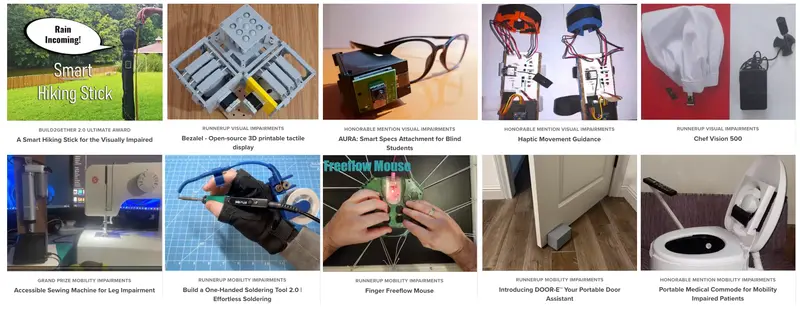
Examples of solutions developed in our innovation contest.
© 2026 Build2Gether. All rights reserved.