Moonshots or Safe Bets? How AI Recommendations Shape Innovation Evaluation
Our field experiment on Hackster.io shows that the sequence of feasibility- and novelty-focused AI recommendations changes what gets selected when feasibility and novelty are in tension.
By Cyrille Grumbach, Jackie Lane, and Georg von Krogh
May 2025
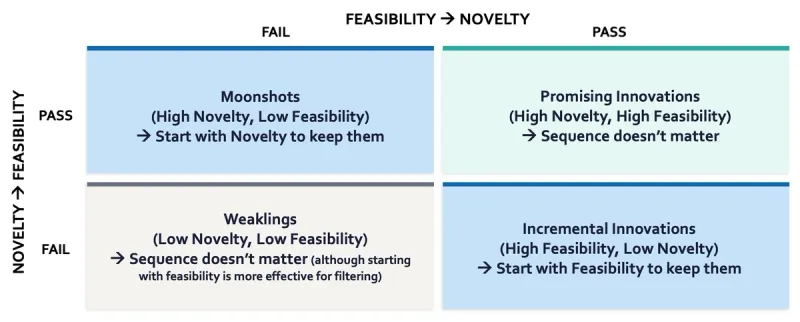
Key takeaway: Sequence matters when feasibility and novelty pull in different directions. If you want reliable incremental innovations, use feasibility-focused AI recommendations first and novelty-focused AI recommendations second; if you want moonshots, reverse the order.
This project looks at a practical question that many organizations now face: when people evaluate many possible solutions, should they look at feasibility first or novelty first? How can AI most effectively assist evaluators when multiple criteria must be considered? That choice may sound small, but it can shape which ideas survive and which ones get filtered out.
To study this, we partnered with Hackster.io, a leading crowdsourcing platform. We first launched an innovation contest that generated 132 open-source solutions. Then we run a series of preregistered field experiments with thousands of evaluators from Sairam Institutions (India) using a two-stage evaluation process. Evaluators were randomly assigned to one of two sequences: feasibility-then-novelty or novelty-then-feasibility. In both cases, AI recommendations helped guide evaluators during the evaluation process.
The main finding is straightforward and highly relevant for practice. When evaluators started with feasibility, they were more likely to keep solutions that worked within existing constraints and then identify the more novel options within that set. This makes feasibility-then-novelty a strong choice when the goal is reliable incremental innovations: solutions that may be less novel, but are highly feasible.
The main finding is clear and highly relevant for practice. When evaluators received feasibility-focused AI recommendations first, they were more likely to keep solutions that worked within existing constraints and then identify the more novel options within that set. This makes the feasibility-then-novelty sequence a strong choice when the goal is reliable incremental innovation: solutions that are highly feasible but not so novel.
The reverse sequence produced a different outcome. When evaluators received novelty-focused AI recommendations first, they were more likely to keep unusual and atypical solutions early on, before feasibility was considered later. That sequence was better at surfacing more extreme possibilities. In practice, this makes novelty-then-feasibility the better option when the goal is moonshots: solutions that are highly novel but not feasible given existing constraints.
The broader lesson is that organizations should not treat the order of AI recommendations as a minor design detail. The sequence matters when feasibility and novelty are in tension; it becomes a real strategic lever. Teams looking for dependable, near-term outcomes should begin with feasibility-focused AI recommendations. Teams looking for bold bets and future breakthroughs should begin with novelty-focused AI recommendations.
Check out how our work was covered by Harvard Business School:
https://d3.harvard.edu/how-ai-can-spot-your-next-billion-dollar-idea/
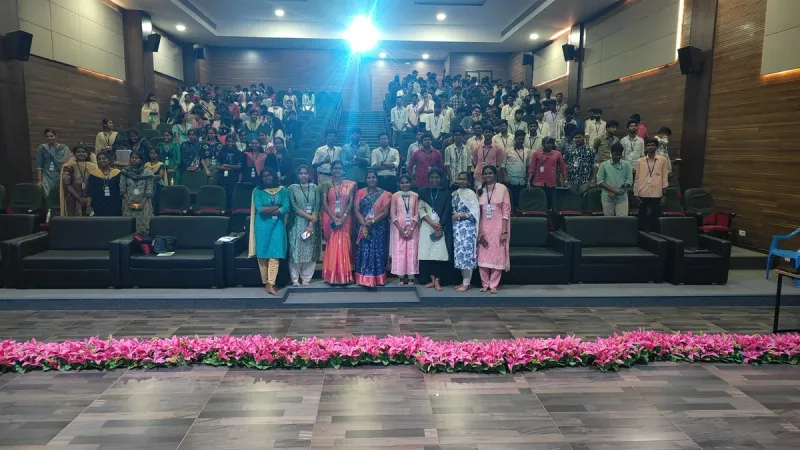
Thanks to all the participants of our experiments from Sairam Institutions.
© 2026 Build2Gether. All rights reserved.